













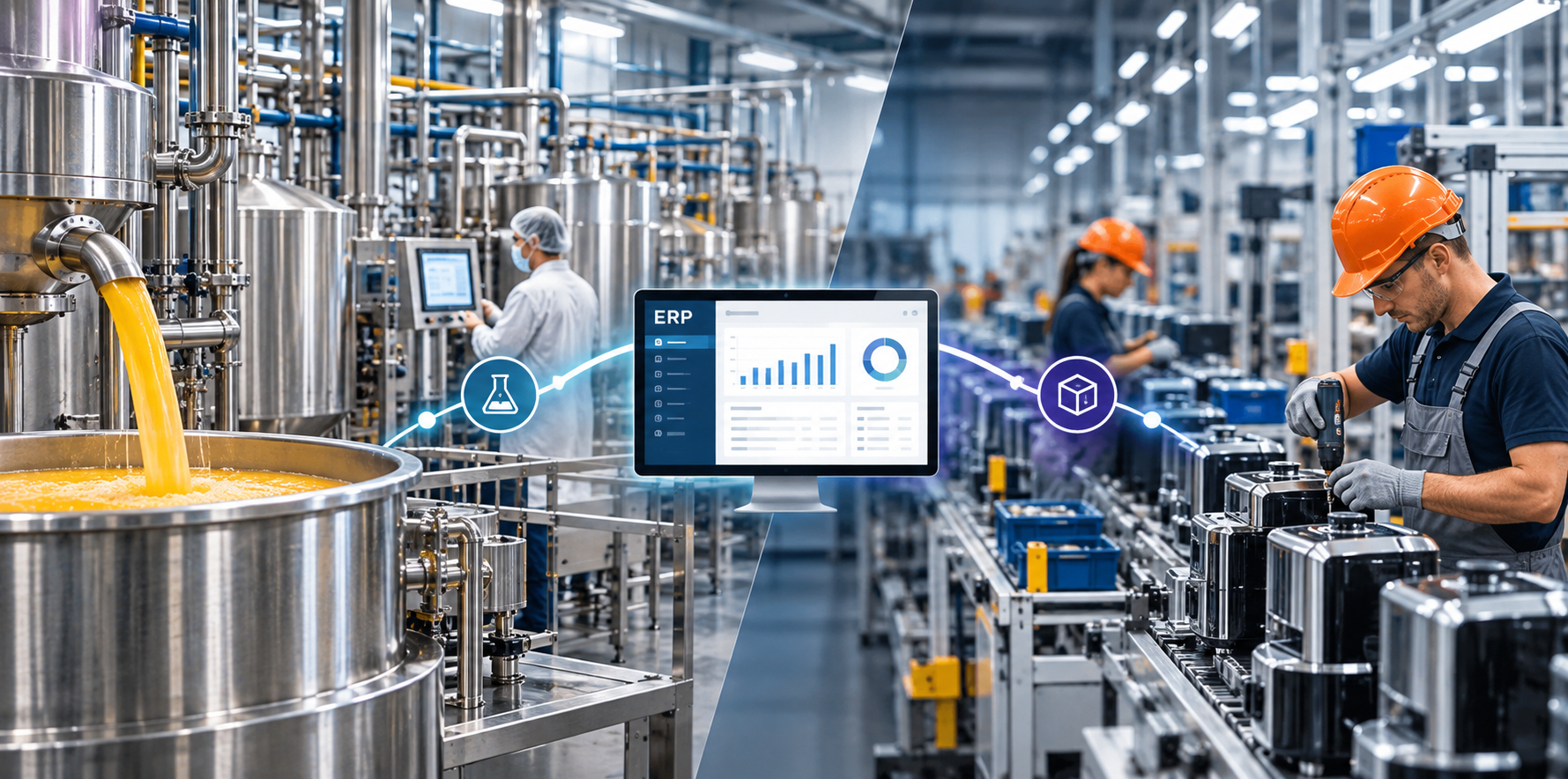
One factory can produce a batch of orange juice in the morning and assemble electric juicers in the afternoon. But can both be managed the same way?
Consider a company that produces orange juice and also manufactures electric juicers. The orange juice is produced in batches using ingredients that are processed and blended together. At the same time, the juicers are assembled from individual components such as motors, housings, filters, and power cords.
This is a perfect example of mixed-mode manufacturing, where a business uses two different modes of manufacturing to produce different types of products.
At first, managing both may not seem like a big challenge. But the two production methods work in very different ways. Process Manufacturing typically revolves around formulas, batches, quantities, and yields, while Discrete Manufacturing focuses on components, assemblies, and operations. So, how can a manufacturer manage both without creating separate processes and systems for each?
The key is to have an ERP system that supports both manufacturing methods while keeping their workflows distinct. This allows the business to use the right production approach for each product while still managing common functions such as inventory, planning, purchasing, and production in one system.
In this blog, we’ll explore:
- What Is Mixed-Mode Manufacturing?
- Process vs. Discrete Manufacturing: Key Differences
- Why Would a Manufacturer Need Both?
- A Real-World Example: One Company, Two Manufacturing Methods
- The Real Challenge: Two Workflows, One Business
- What Happens When the Two Manufacturing Methods Are Managed Separately?
- How Does an ERP Know Which Manufacturing Method to Use?
- Why Keeping the Workflows Separate Matters
- How Can Manufacturers Manage Both Without Mixing Them Up?
- Is Hybrid Manufacturing the Same as Mixed-Mode Manufacturing?
- What Should You Look for in a Mixed-Mode Manufacturing ERP?
- How Does Co-Existence Support Mixed-Mode Manufacturing?
- How Is the Manufacturing Type Controlled?
- What Does This Mean for the Manufacturer?
- Final Thoughts
What Is Mixed-Mode Manufacturing?
Mixed-mode manufacturing is an environment where a manufacturer uses more than one manufacturing method within the same organization or plant. In this blog, we’ll use Process Manufacturing and Discrete Manufacturing as the two modes to explain how mixed-mode manufacturing works.
The two methods have different production characteristics.
Process Manufacturing generally produces products through formulas, recipes, batches, and controlled processing. Discrete Manufacturing, on the other hand, produces identifiable units by assembling individual components according to a Bill of Material (BOM) and defined production processes.
The important point is that mixed-mode manufacturing does not mean combining the two methods into one manufacturing workflow. Instead, both methods can operate within the same manufacturing environment, with each product following the production model that is appropriate for how it is made.
Process vs. Discrete Manufacturing: Key Differences
Although both methods can operate within the same manufacturing environment, they differ in how products are made, tracked, and produced. The table below highlights the key differences between Process and Discrete Manufacturing.
| Manufacturing Aspect | Process Manufacturing | Discrete Manufacturing |
|---|---|---|
| Production Approach | Process or Batch-oriented | Unit or Assembly-oriented |
| Primary Structure | Formula or Recipe | Bill of Material (BOM) |
| Typical Quantities | Weight, volume, batch quantity | Pieces or units |
| Material Transformation | Ingredients are processed or transformed | Components are assembled |
| Common Examples | Food & beverages, Chemicals, Cosmetics, Pharmaceuticals | Automotive, Aerospace, Industrial machinery & equipment |
| Common Tracking Needs | Batch/lot and yield | Individual units and components |
Why Would a Manufacturer Need Both?
A manufacturer does not necessarily choose Process or Discrete Manufacturing once and use it for every product. As a business grows, its products, production requirements, or even its facilities can change. For example, a company that originally manufactured only beverages may later add equipment, accessories, or packaged products to its portfolio. The original products may still require Process Manufacturing, while the new products may require Discrete Manufacturing.
This can happen when:
- A manufacturer adds a completely different product line.
- A process manufacturer begins producing equipment or accessories.
- A company produces bulk materials and separately assembles finished products.
- A business acquires another manufacturer that uses a different production method.
- Different plants within the same organization use different manufacturing methods.
In each case, the business is no longer working with just one manufacturing model. It needs to support different production methods while still operating as one business.
A Real-World Example: One Company, Two Manufacturing Methods
Consider a company that produces packaged orange juice and also manufactures electric juicers.
Product 1: Orange Juice
- Fresh oranges are washed, sorted, crushed, filtered, blended, and processed into orange juice.
- The production team works with ingredients, formulas, batches, and production yields.
This is Process Manufacturing.
Product 2: Electric Juicer
The company also manufactures electric juicers. Each finished juicer is assembled from components such as:
- Electric motor
- Plastic housing
- Stainless steel filter
- Juicing cone
- Power cord
- Control switch
- Packaging components
These components are assembled into an identifiable finished unit. This is Discrete Manufacturing.
The company therefore has two different ways of producing its products, even though both products belong to the same business.
The Same Pattern Appears Across Industries
The orange juice and electric juicer example is only one way mixed-mode manufacturing can occur. The same combination can appear across many industries:
| Industry | Process Manufacturing | Discrete Manufacturing |
|---|---|---|
| Food & Beverage | Fruit jam, soft drinks | Toasters, vending machines |
| Dairy | Flavored yogurt or dairy products | Refrigerators |
| Paint & Chemicals | Industrial paint or coatings | Paint sprayers |
| Cosmetics | Shampoo, creams, or lotions | Hair dryers or cosmetic equipment |
| Pharmaceuticals | Cough syrup | Medical devices such as nebulizers |
| Construction Materials | Ready-mix concrete | Concrete mixers |
The Real Challenge: Two Workflows, One Business
Having two manufacturing methods is not necessarily the difficult part. The bigger challenge is managing both without losing the connection between them.
The production teams need different manufacturing tools and workflows. A Process Manufacturing team may need to work with formulas, batches, quantities, yields, and lot tracking. A Discrete Manufacturing team may need BOMs, components, operations, and production orders.
At the same time, both teams are part of the same business. They may share:
- Inventory
- Purchasing
- Sales
- Material planning
- Warehouse
- Financial data
- Quality processes
This creates an important requirement: production workflows need to remain separate, while the business information supporting them needs to remain connected. That is where managing mixed-mode manufacturing becomes an ERP challenge.
What Happens When the Two Manufacturing Methods Are Managed Separately?
Using separate systems for Process and Discrete Manufacturing can create additional coordination requirements.
For example, teams may need to synchronize product and inventory information between applications, coordinate production planning manually, or consolidate reports from different systems. The exact impact depends on the systems and integrations involved, but the underlying problem is common: the manufacturing methods are different, while the business still needs a unified view.
A mixed-mode ERP environment should therefore do more than provide two unrelated manufacturing modules. It should allow the manufacturer to maintain the appropriate production workflow for each product while sharing common business functions.
How Does an ERP Know Which Manufacturing Method to Use?
This is one of the most important technical questions in a mixed-mode environment. An ERP cannot simply assume that every product should use the same production process. The system needs a way to identify whether a finished good belongs to Process Manufacturing or Discrete Manufacturing.
A practical approach is to establish the manufacturing classification at the product and transaction levels.
- Item Class / Category sets a default manufacturing method for a group of similar items.
- Stock Item / Product Master confirms the specific method (Process or Discrete) for that individual item, inheriting the default but allowing overrides.
- Both methods generate an execution-level order, but the source document differs. A Formula for Process Manufacturing versus a BOM for Discrete Manufacturing, and each order type tracks output differently: batch/yield for Process, unit quantity for Discrete.
This type of configuration helps prevent users from selecting an inappropriate production workflow.
Why Keeping the Workflows Separate Matters
It may seem simpler to create one universal manufacturing structure for everything. In practice, that can make production management more complicated.
Process Manufacturing may need to account for batch quantities, yields, formulation, lots, and processing stages. Discrete Manufacturing may need to account for individual components, operations, assembly quantities, and production orders. For that reason, a mixed-mode manufacturing environment should not try to make Process and Discrete Manufacturing identical.
Instead, it should allow each method to retain the structure it needs.
How Can Manufacturers Manage Both Without Mixing Them Up?
A mixed-mode manufacturing environment needs clear controls around product classification and production execution.
- Classify products correctly: The system should identify which finished goods are intended for Process Manufacturing and which are intended for Discrete Manufacturing.
- Use the appropriate production structure: Process products should use the structures and transactions designed for process production. Discrete products should use BOMs and discrete production orders.
- Prevent incorrect transactions: A product classified for Process Manufacturing should not accidentally be used in a discrete manufacturing transaction, and vice versa.
- Share common business functions: Although production workflows differ, manufacturers should ideally be able to manage inventory, purchasing, sales, and planning within the same business environment.
- Maintain visibility across production: Management should not have to manually combine information from two manufacturing systems simply to understand overall production activity.
Is Hybrid Manufacturing the Same as Mixed-Mode Manufacturing?
The terms can sometimes overlap in ERP and manufacturing discussions, but they should not automatically be treated as identical.
Mixed-mode manufacturing is the clearer term when discussing an environment that combines Process Manufacturing and Discrete Manufacturing.
Hybrid manufacturing, meanwhile, can have other meanings in manufacturing technology, including manufacturing approaches that combine additive and subtractive processes.
For this reason, manufacturers researching ERP solutions should look at what a vendor actually means by “hybrid” or “mixed-mode” rather than assuming the terms describe the same capability. For Process + Discrete ERP discussions, mixed-mode manufacturing is the more precise term.
What Should You Look for in a Mixed-Mode Manufacturing ERP?
If a manufacturer needs both Process and Discrete Manufacturing, several capabilities become particularly important.
| Capability | Why It Matters |
|---|---|
| Process Manufacturing | Supports formulas, batches, quantities, and yields for process-produced items |
| Discrete Manufacturing | Supports BOMs, components, operations, and production orders for discrete products |
| Product Classification | Identifies whether an item is configured for Process or Discrete Manufacturing |
| Transaction Controls | Helps ensure that items are processed through the appropriate manufacturing workflow |
| Inventory Integration | Provides a shared view of inventory while supporting the different requirements of Process and Discrete Manufacturing |
| Material Planning | Supports planning requirements for both formula-based Process items and BOM-based Discrete items |
| Purchasing | Supports procurement of the different materials and components required for Process and Discrete production |
| Sales Integration | Supports production requirements generated from sales demand for both Process and Discrete products |
| Lot and Batch Tracking | Supports traceability requirements for materials and products where batch or lot tracking is applicable |
| Quality Management | Supports quality processes for products manufactured through different production methods |
| Reporting | Provides visibility into production across different manufacturing methods and measurement requirements |
How Does Co-Existence Support Mixed-Mode Manufacturing?
Mixed-mode manufacturing describes the business environment where an organization needs both Process Manufacturing and Discrete Manufacturing.
eWorkplace Apps’ Co-Existence is a feature designed to support that environment by allowing both manufacturing methods to operate within the same ERP while maintaining their separate workflows. For Process Manufacturing products, users can work with Process Manufacturing formulas and Batch production. For Discrete Manufacturing products, users can use standard Acumatica BOMs and Production Orders. The two workflows remain separate, while common business functions such as inventory, planning, procurement, and sales remain within the same ERP environment.
The purpose is not to merge the workflows. It is to make sure that each product follows the workflow appropriate to its manufacturing method without requiring the business to operate two disconnected ERP environments.
How Is the Manufacturing Type Controlled?
Co-Existence allows Process and Discrete Manufacturing to be configured and managed within the same tenant (business environment within the ERP). Manufacturers do not need to create separate tenants to use the two manufacturing methods.
Within that single tenant, the manufacturing type can be controlled at several levels:
- Item Class – The Process Manufacturing setting can provide the default classification for Stock Items created under that class.
- Stock Item – The Process Manufacturing setting determines whether a finished good is designated for Process Manufacturing or Discrete Manufacturing.
- Production Order Type – The Process Manufacturing setting identifies whether the production order type is intended for Process Manufacturing or Discrete Manufacturing.
This configuration provides a control mechanism for the manufacturing workflow.
A Process Manufacturing finished good can be used with its Process Manufacturing Formula and Batch workflow, while a Discrete Manufacturing finished good can use a standard BOM and Production Order. The system also applies controls to prevent the manufacturing methods from being incorrectly mixed.
What Does This Mean for the Manufacturer?
Return to the Orange Juice example. The company produces two very different types of products, and each requires a different manufacturing approach.
Orange Juice
Formula → Batch → Process Manufacturing
Electric Juicer
BOM → Production Order → Discrete Manufacturing
The orange juice continues to follow the Process Manufacturing workflow, while the electric juicer follows the Discrete Manufacturing workflow. The company does not need to standardize both products on the same manufacturing method simply because they are produced by the same business.
Instead, each product can follow the manufacturing process that matches how it is actually produced, while shared business functions remain connected within the same ERP environment.
Final Thoughts
Manufacturing does not always fit into a single production model. A company can produce beverages, chemicals, or cosmetics through Process Manufacturing while also producing equipment, machines, or other assembled products through Discrete Manufacturing. As product portfolios become more diverse, the ability to support both methods becomes increasingly important.
The goal of mixed-mode manufacturing is not to make Process and Discrete Manufacturing identical. It is to allow each manufacturing method to work the way it needs to while keeping the broader business connected.
The Co-Existence feature can provide the framework for this model by identifying the appropriate manufacturing method, controlling which transactions are available, and allowing Process and Discrete Manufacturing to operate within the same ERP environment.
For manufacturers, the real question is therefore not simply, “Can we run Process and Discrete Manufacturing?”
It is: “Can we run both in the way each requires, while still managing the business as one connected operation?”
Contact us to learn how Co-Existence can help you manage both manufacturing methods within a single ERP environment while keeping their workflows separate.
Frequently Asked Questions
-
Can one ERP system manage both Process and Discrete Manufacturing?
Yes, if the ERP supports both manufacturing models and provides controls to distinguish the applicable production workflow.
-
What happens if the wrong manufacturing workflow is used for an item?
Transaction controls can restrict or prevent users from applying an incompatible manufacturing workflow, helping ensure that Process items follow Process transactions and Discrete items follow Discrete transactions.
-
What should a manufacturer consider before implementing mixed-mode manufacturing?
The manufacturer should determine which products require Process or Discrete Manufacturing, how inventory and planning will be shared, how production transactions will be controlled, and whether the ERP can support both manufacturing models without forcing them into a single workflow.
-
What should you look for in an ERP for mixed-mode manufacturing?
Look for support for both Process and Discrete workflows, product classification, shared inventory and planning, transaction controls, and traceability across different production methods.
-
Can Process and Discrete products share the same inventory?
Yes. Both types of products can be managed within a shared inventory environment while their production transactions follow the appropriate manufacturing workflow.
Contact Us