













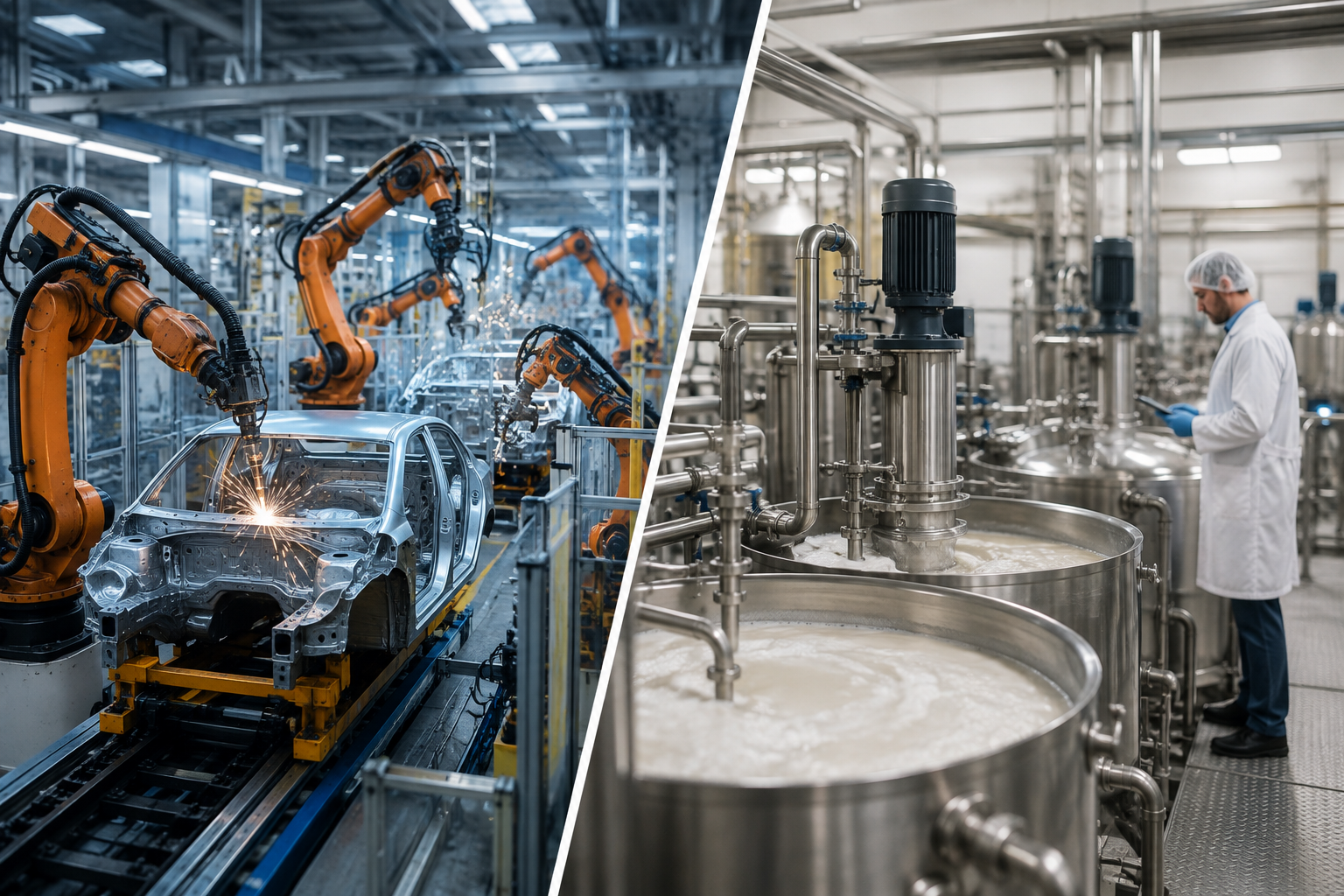
Manufacturing may have one goal, but there is more than one way to achieve it.
Not every product is made the same way. The materials used, how they are processed, how production is planned, and even how the finished product is measured can vary from one industry to another.
This is where Discrete Manufacturing and Process Manufacturing come in. While both approaches turn raw materials into finished products, the way they handle production is quite different. Discrete manufacturing generally focuses on producing individual, identifiable, and often reversible products through a series of operations or assembly steps. Process manufacturing, on the other hand, uses formulas/recipes or controlled processes to transform or combine materials into a finished product.
So, what exactly makes these two manufacturing approaches different? And how does that difference affect production, material management, and quality? Let’s take a closer look at Discrete vs. Process Manufacturing. We’ll explore:
- What Is Discrete Manufacturing?
- What Is Process Manufacturing?
- Discrete vs. Process Manufacturing: What Is the Difference?
- Real-World Examples: Discrete vs. Process Manufacturing
- Can a Manufacturer Use Both Discrete and Process Manufacturing?
- Quality Management in Discrete and Process Manufacturing
- Managing Production in Process Manufacturing
- Choosing the Right Manufacturing Approach
- Final Thoughts
What Is Discrete Manufacturing?
Discrete Manufacturing is used to make individual, identifiable products or units. Products are usually made by bringing different components together through a defined series of production or assembly steps.
For example, in the automobile industry, the finished product is made by assembling components such as the engine, tires, seats, electronics, and internal parts. The vehicle becomes a distinct finished product, while each component can be identified separately. Also, these components can be individually tracked and disassembled from the finished product.
In discrete manufacturing, a Bill of Materials (BOM) is commonly used to define the components needed to make a product, while routings or operations define the steps involved in assembling or producing it.
Discrete manufacturing is commonly found in industries such as:
- Automotive
- Electronics
- Aerospace and Defense
- Industrial Machinery and Equipment
- Furniture
- Consumer Appliances
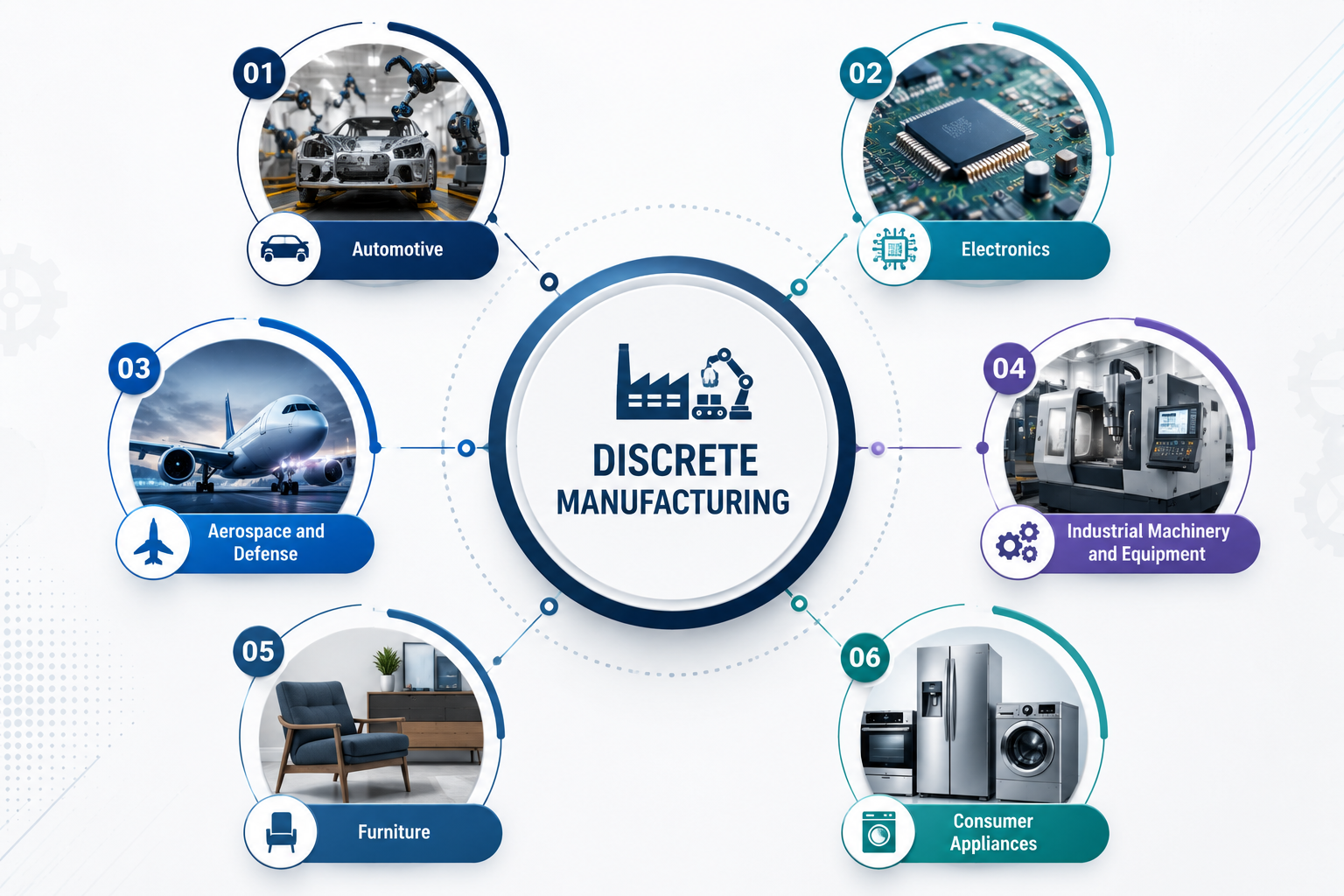
The exact production process can vary depending on the product, but the basic approach is the same: different components go through defined operations and come together to create a finished product.
What Is Process Manufacturing?
Process Manufacturing is used when materials are mixed, transformed, or processed to create a finished product. Instead of assembling separate components, manufacturers typically work with ingredients or raw materials in specific quantities and process them through a series of production stages.
For example, a beverage manufacturer may combine water, fruit concentrate, sweeteners, and other ingredients according to a defined formula. The mixture then goes through different stages such as processing, filling, and packaging before becoming the finished beverage.
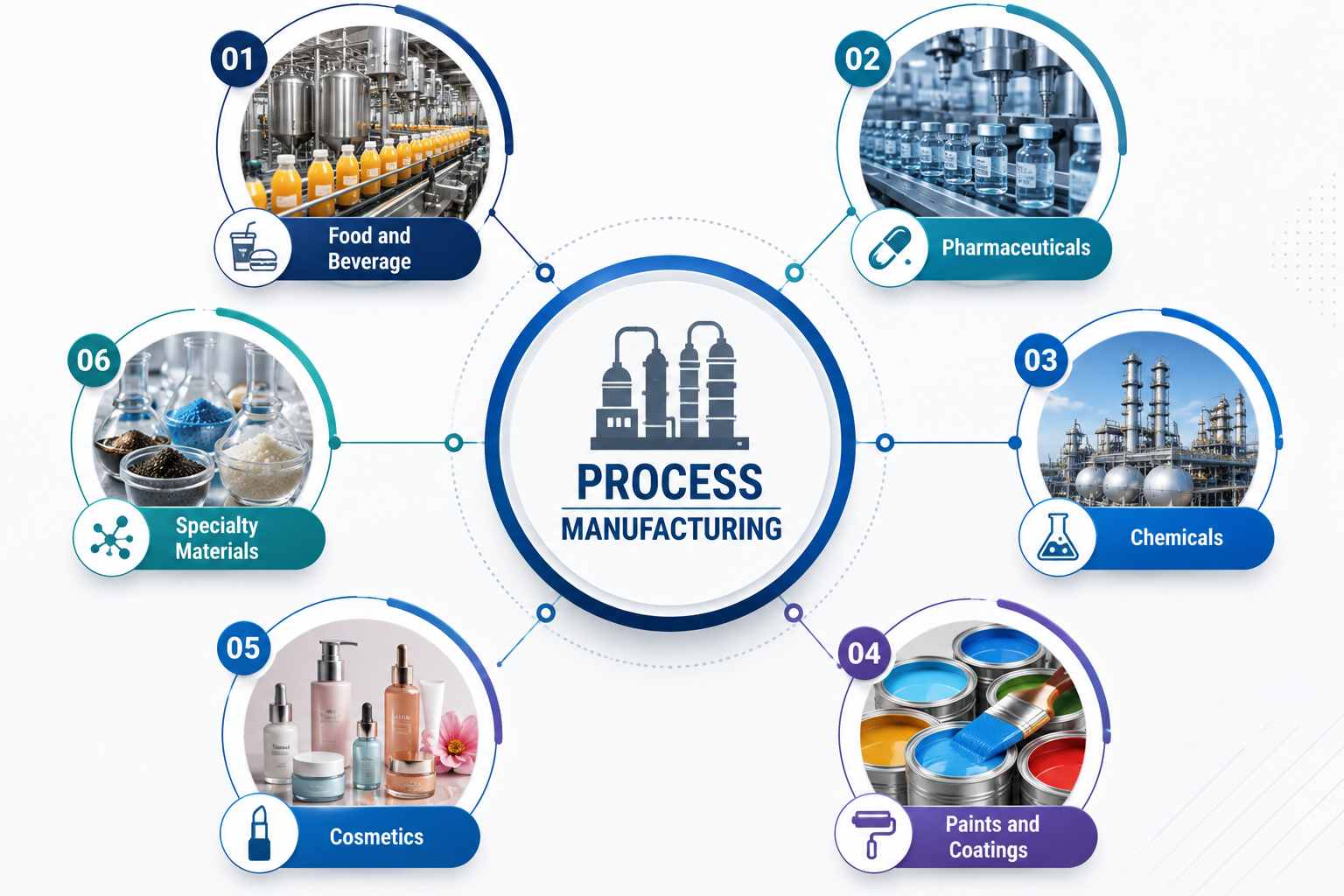
Process manufacturing is commonly used in industries such as:
- Food and Beverage
- Pharmaceuticals
- Chemicals
- Paints and Coatings
- Cosmetics
- Specialty Materials
Depending on the product and the production requirements, manufacturers may produce goods in batches or through continuous production. They also need to consider factors such as material consumption, yield, lot traceability, quality specifications, and variations in raw materials throughout the production process.
Another important aspect of process manufacturing is that production may result in more than one planned output. For example, a single production process can produce a primary product along with co-products or by-products. This can make production planning and material management more complex.
Discrete vs. Process Manufacturing: What Is the Difference?
Both Discrete Manufacturing and Process Manufacturing have the same basic goal, which is to turn raw materials into finished products. What changes is how those products are made.
The following comparison highlights some of the key differences between the two manufacturing models:
| Area | Discrete Manufacturing | Process Manufacturing |
|---|---|---|
| Production approach | Products are assembled or manufactured through defined operations. | Materials are mixed/combined, transformed, or processed through defined processes. |
| Production structure | Often based on a Bill of Materials (BOM) and routing. | Often based on formulas/recipes. |
| Typical output | Individual, identifiable products or units. | Finished products produced from ingredients or raw materials. |
| Material measurement | Commonly measured in units, each, pieces, or quantities. | Measured by weight, volume, quantity, concentration, or other specifications. |
| Production methods | Often involves assembly and sequential operations. | Can involve batch or continuous production. |
| Traceability | Components and finished products can be tracked individually or by lot/serial number. | Raw materials, ingredients, batches, and finished products are often tracked by lot. |
| Product variations | Often involve different models, configurations, sizes, or components. | Often involve different formulas, grades, concentrations, or formulations. |
| Production output | Generally results in a planned finished product or assembly. | A process may produce a primary product along with co-products or by-products. |
| Common industries | Automotive, electronics, machinery, furniture, and appliances. | Food and beverage, pharmaceuticals, chemicals, cosmetics, and paints. |
Real-World Examples: Discrete vs. Process Manufacturing
1. Process Manufacturing: Cosmetics
A cosmetics manufacturer produces a face cream by combining oils, emulsifiers, fragrances, and other ingredients according to a defined formulation. The materials go through controlled mixing and processing stages before the finished cream is filled and packaged.
2. Discrete Manufacturing: Medical Devices
A medical device manufacturer produces infusion pumps by assembling components such as sensors, control boards, motors, tubing, displays, and housings through defined assembly and testing operations.
3. Both Process and Discrete Manufacturing: Industrial Equipment Manufacturer
An industrial equipment manufacturer may produce a specialized coating material using Process Manufacturing and then manufacture coating machines using Discrete Manufacturing. The coating is formulated by combining raw materials according to a defined process, while the machines are produced by assembling individual components.
Can a Manufacturer Use Both Discrete and Process Manufacturing?
Yes. Many manufacturers may have products that require different manufacturing approaches. One product may be produced using a process manufacturing workflow, while another may require discrete manufacturing.
For example, a beverage manufacturer uses Process Manufacturing to produce orange juice by processing and blending ingredients. As the company expands, it also starts manufacturing electric juicers, which use Discrete Manufacturing because they are assembled from individual components.
Managing these two approaches separately can create additional complexity. Manufacturers may have to maintain separate manufacturing workflows, coordinate data across processes, and accommodate different production requirements.
This is where eWorkplace Apps’ Co-Existence feature can help.
How Co-Existence Works
The Co-Existence feature allows organizations to use both Discrete Manufacturing and Process Manufacturing within the same ERP environment. Each product can follow its appropriate manufacturing workflow while common business functions remain integrated.
The system can identify whether an item is configured for Process Manufacturing or Discrete Manufacturing and direct it through the corresponding workflow. Process Manufacturing items can use formulas and batch production, while Discrete Manufacturing items can continue to use standard BOMs and production orders.
At the same time, both manufacturing approaches can share common business functions such as inventory management, planning, procurement, and reporting.
This means a manufacturer does not have to choose between the two manufacturing models simply because different products require different production methods. Both can operate within the same ERP environment while maintaining their respective manufacturing workflows.
Quality Management in Discrete and Process Manufacturing
In Discrete Manufacturing, quality management generally focuses on components, assemblies, production operations, and finished products. Manufacturers may need to verify that products meet defined specifications before they move to the next stage or are released.
In Process Manufacturing, quality management is often closely connected to raw materials, formulas, batches, processing stages, and finished-product specifications. Quality checks may be performed at different points throughout the production process to ensure that materials and products continue to meet the required standards.
This is why quality management needs to be part of the production process rather than something that happens only at the end. Identifying quality issues at the right stage allows manufacturers to take action before they affect further production or the finished product.
For manufacturers working with both Discrete Manufacturing and Process Manufacturing, eWorkplace Apps’ Quality Management Suite (QMS) provides quality management capabilities that integrate with manufacturing operations, helping to manage quality throughout the production lifecycle.
Managing Production in Process Manufacturing
For process manufacturers, managing production often involves more than simply recording what was produced. Manufacturers may need to manage formulas, ingredients, batches, material consumption, production stages, and variations in output.
Co-Products Add Another Layer of Complexity. One area that makes process manufacturing particularly different is co-product production.
A single manufacturing process can intentionally produce multiple valuable outputs. For example, in dairy processing, a batch of raw milk can be processed into products such as milk, cream, and other outputs.
Instead of treating these additional outputs as unexpected waste, manufacturers may need to plan, track, and account for them as part of the production process.
This is one of the areas where process manufacturing requires capabilities that go beyond a traditional discrete manufacturing approach.
eWorkplace Apps’ PMS supports process manufacturers with capabilities designed around these types of production requirements, including co-product management.
Choosing the Right Manufacturing Approach
So, how do you know which manufacturing model fits your business?
The answer depends largely on how your products are made and what you need to manage throughout production.
Discrete Manufacturing may be a better fit when:
- Products are individual and easily identifiable.
- Production involves assembling separate components.
- BOMs and routings define how products are made.
- Product configurations and variants are common.
- Components need to be individually tracked or identified.
Process Manufacturing may be a better fit when:
- Products are made by combining or transforming materials.
- Production is driven by formulas/recipes.
- Materials are measured by weight, volume, quantity, or other specifications.
- Batch or continuous production is common.
- Yield and material consumption are important.
- Lot traceability is required.
- Co-products or by-products can result from production.
Both may be required when:
- A business has both formulation and assembly operations.
- Processed materials are later packaged.
- Different divisions or product lines follow different production models.
- The business needs to manage process and discrete operations within the same ERP environment.
Final Thoughts
Discrete Manufacturing and Process Manufacturing may have the same end goal, but they take different paths to get there.
Discrete manufacturing focuses on identifiable products and components that move through defined operations, while process manufacturing focuses on transforming or combining materials through formulas/recipes and controlled processes.
For manufacturers, understanding this difference is important because it affects much more than production. It influences material planning, inventory management, traceability, scheduling, and quality management.
And for businesses that operate across both models, the goal should not be to choose one simply because it is more common. The better approach is to understand how each part of the business operates and use systems that can support those requirements.
With eWorkplace Apps, manufacturers can use Process Manufacturing Suite (PMS) to support process-driven production and Quality Management Suite (QMS) to support quality activities across the manufacturing lifecycle. Together, they can help connect production and quality processes while providing better visibility and control over manufacturing operations.
Contact us to find the right manufacturing approach for the way you make your products.
Frequently Asked Questions
-
What is the difference between discrete and continuous manufacturing processes?
Discrete manufacturing produces individual, countable products through defined operations, while continuous manufacturing produces materials continuously with minimal interruption. Process manufacturing can use either batch or continuous production, depending on the product and process.
-
How does traceability work differently in discrete and process manufacturing?
In discrete manufacturing, traceability focuses on individual components, assemblies, and finished products, often using lot or serial numbers. In process manufacturing, traceability commonly follows raw materials, batches, formulas, processing stages, and finished-product lots.
-
What challenges can arise when managing discrete and process manufacturing in separate systems?
Managing discrete and process manufacturing in separate systems can lead to duplicate data, disconnected production planning, inconsistent inventory records, and limited visibility across operations.
-
How does material consumption vary between discrete and process manufacturing?
Discrete manufacturing typically consumes defined quantities of individual components to produce a specific number of units. Process manufacturing may consume ingredients or raw materials based on formulas, batch sizes, yields, and processing requirements.
-
How can manufacturers reduce downtime between production batches?
Manufacturers can reduce downtime by improving production scheduling, planning changeovers, and ensuring the required materials, equipment, and resources are ready before the next batch begins. Standardizing cleaning, setup, and changeover procedures can also help reduce the time between batches.
-
What challenges arise when you use a discrete manufacturing system to manage process manufacturing?
A discrete manufacturing system may struggle to handle process-specific requirements such as material yield, production loss, batch sizing, formulas, and variable consumption. This can make it harder for manufacturers to accurately track material consumption, inventory, production costs, and lot traceability.
Contact Us