













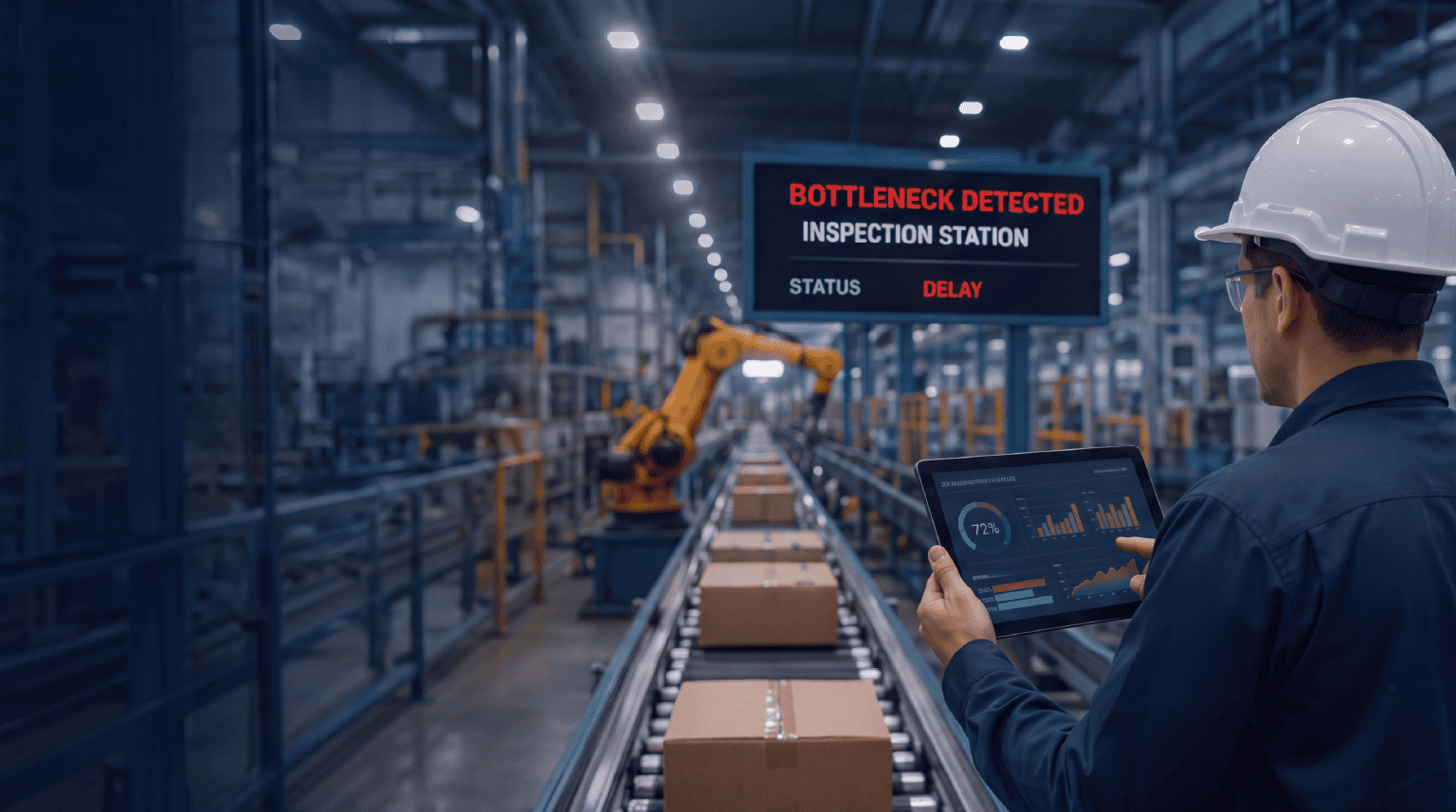
You can’t always see a manufacturing bottleneck coming. But you can always feel it.
Imagine a typical day on the production floor. It is 10:00 AM. The machines are running, operators are at their stations, and orders are scheduled. Everything appears to be on track, but production is falling behind. At first, nothing seems obviously wrong. But then the production manager takes a close look.
One batch is waiting for raw material. Another is sitting on quality hold. One production stage is moving slower than the stage before it, creating a growing pile of work-in-process inventory. Meanwhile, an operator is spending time trying to find the right ERP screen to check a production status. The production line is running. But the production flow is not.
This is what a manufacturing bottleneck can look like.
Before you can eliminate a bottleneck, you first need to understand where it is coming from and how it is affecting the rest of the production process. Once you identify the root cause, the next step is to take the right actions to resolve it and prevent it from recurring. So, how can a manufacturing company identify these constraints early, address their root causes, and prevent them from disrupting production?
As we go through this blog, you will explore:
- What Is a Manufacturing Bottleneck?
- Common Sources of Manufacturing Bottlenecks
- How Do You Find a Manufacturing Bottleneck?
- How Better Production Data Can Help Fix Manufacturing Bottlenecks
- How to Prevent Manufacturing Bottlenecks Caused by Quality Problems
- How AI Can Reduce Manufacturing Bottlenecks Caused by Information Gaps
- Final Thoughts
What Is a Manufacturing Bottleneck?
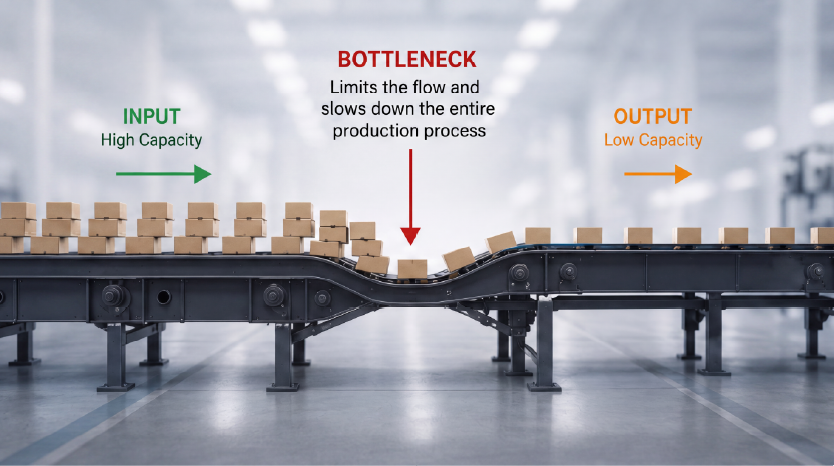
A manufacturing bottleneck is a production stage, resource, or activity that limits the overall flow of production. When one part of the process cannot keep up with the required production rate, work begins to accumulate around that point.
One example is equipment-related downtime, where a machine failure temporarily reduces the capacity of a production process. According to Siemens’ The True Cost of Downtime 2024 report, a large plant loses an average of 27 hours per month to unplanned downtime. It is more than a full day of production.
Think of a narrow doorway. If 100 people are trying to leave a building but only one narrow door is available, the speed at which everyone can leave is determined by that door, not by how quickly the people behind it can move.
Production works in much the same way.
Imagine a process with four stages:
Material Preparation → Processing → Quality Inspection/Check → Packaging
If the processing stage can handle 1,000 units a day but quality inspection can handle only 600, the inspection stage becomes a constraint. Increasing the capacity of the earlier stage will not solve the problem. It may actually create more waiting and work-in-process inventory.
Common Sources of Manufacturing Bottlenecks
One of the easiest mistakes is to look for bottlenecks only in equipment. A production process can lose capacity even when every machine is technically working.
| Source of Bottleneck | What It Can Look Like | Possible Result |
|---|---|---|
| Capacity bottleneck | One operation cannot process work as quickly as the previous operation | WIP accumulates |
| Material bottleneck | Required raw materials are unavailable during the time of production | Production waits |
| Quality bottleneck | Materials are held for inspection, testing, or investigation | Production schedules are delayed |
| Process bottleneck | A process requires too many manual steps or varies between operators | Longer cycle times |
| Planning bottleneck | Production schedules do not reflect actual capacity or material availability | Resources are poorly utilized |
| Information bottleneck | Employees cannot quickly find the information needed to make a decision or perform a task | Decisions and execution slow down |
This is why simply adding another machine or asking employees to work faster does not necessarily resolve a manufacturing bottleneck or improve manufacturing efficiency.
The first step is to understand what is actually happening across the production floor. Having better visibility into machines, people, processes, and production data can help manufacturers see where production is slowing down and why.
This is where Smart Factory MOM can help manufacturers. It connects different parts of the manufacturing operation to provide greater visibility and support faster, data-driven decisions. Learn more about Smart Factory MOM.
With that visibility in place, the next question is:
What is actually preventing the production flow from moving?
How Do You Find a Manufacturing Bottleneck?
Finding a bottleneck requires more than asking which machine is slowest. To find it, look at the entire process and pay attention to where work starts waiting, accumulating, slowing down, or being repeated.
1. Map the Production Process
Start by looking at the complete production flow rather than focusing on a single workstation. Map each major stage from planning and material preparation through production, inspection, quality checks, packaging, and finished goods.
For each stage, compare what comes in with what goes out, how long the work takes, and whether work is waiting or being sent back for rework. This helps reveal where the production flow starts to break down.
2. Look for Where Work Accumulates
A growing queue of material or work-in-process (WIP) is one of the clearest signs that a process may be struggling to keep up with the work coming into it.
If WIP consistently builds up before one operation, investigate what is causing the delay. The accumulation is a signal that a constraint may exist, but it is not necessarily the root cause of the problem.
3. Measure Where Time Is Being Lost
Do not look only at how long equipment is running. A process can lose significant time while machines are still operating because employees are waiting for materials, changing over equipment, resolving interruptions, or completing rework.
Track metrics such as cycle time, waiting time, downtime, changeover time, WIP, production interruptions, and rework. Comparing these measures across production stages can help identify where capacity is being lost.
4. Look for Repeated Quality Problems
Quality problems can create bottlenecks just as easily as equipment or material issues. A process that repeatedly produces failed tests, non-conformances, scrap, or rework is consuming production capacity that could otherwise be used for new output.
Look for patterns rather than treating every quality failure as an isolated event. If the same issue keeps appearing, it may point to a process constraint that needs to be addressed.
5. Find the Root Cause
Once you identify where production is slowing down, do not stop at the first visible problem. Ask why the problem is occurring until you reach the underlying cause.
For example, a batch may be delayed because it is waiting for QC. The QC hold may exist because the batch failed a test, and the failed test may have resulted from a process parameter not being maintained within the required range.
The real problem, therefore, is not simply that the batch is waiting for QC. The investigation needs to go further and address the process condition that caused the failure in the first place.
Identifying the bottleneck tells you where the problem appears. Root-cause analysis helps you understand why it happens.
How Better Production Data Can Help Fix Manufacturing Bottlenecks
Finding a manufacturing bottleneck is only useful if you can act on it. Once you understand the cause, having production information in one place helps teams plan better, respond to delays, and keep production moving.
This is where eWorkplace Apps’ Process Manufacturing Suite (PMS) can help. Here’s how:
1. Plan Production Clearly
PMS connects formulas, BOMs, routings, production orders, material requirements, and batch details, giving teams a clear view of what and how much to be produced.
2. Reduce Material Delays
Material shortages can bring production to a stop. PMS helps teams manage material requirements, allocation, and staging so that materials are available when production needs them.
3. Keep Batches Moving
When production involves multiple batches or sub-batches, delays in one stage can affect the next. Batch, Super Batch, and Sub-Batch Scheduling help teams coordinate related production activities and keep work moving.
4. Follow a Consistent Process
Defined formulas, BOMs, routings, and production instructions give operators a consistent process to follow, reducing variation caused by different ways of working.
5. Learn From Production Results
Comparing planned and actual quantities, material usage, production time, and batch performance helps teams spot recurring issues and find opportunities to improve manufacturing efficiency.
The goal is not just to collect production data, but to use it to identify problems, reduce delays, and improve how production runs.
How to Prevent Manufacturing Bottlenecks Caused by Quality Problems
A quality issue can quickly become a manufacturing bottleneck when it is not identified and addressed early. A failed test, non-conformance, or process deviation can lead to rework, scrap, additional processing, and production delays, affecting the flow of everything that follows.
This is where production and quality need to work together. While PMS helps manage production activities, eWorkplace Apps’ Quality Management Suite (QMS) helps manufacturers perform quality checks, define sampling requirements, record results, identify non-conformances, and take action when something does not meet the required specifications. A few ways QMS helps stop quality issues from becoming bottlenecks:
1. Catch Problems Earlier
Quality checks at the right stages can identify defects before they move further through production.
Produce → Inspect/Test → Identify Issue → Correct → Continue
Finding an issue early can reduce rework, scrap, and downstream delays.
2. Connect Quality Results to Production
A QC result can determine whether materials can pass, fail, be held, or require further action. This helps production teams make decisions based on actual quality results instead of discovering problems later.
3. Address Recurring Quality Problems
Fixing one failed batch solves the immediate problem. Non-conformance management and CAPA help identify why the problem keeps occurring and address its root cause.
But not every manufacturing bottleneck happens on the production floor. Sometimes, the problem is simply that people cannot find the information they need quickly enough.
For example, a shop-floor employee may not know which ERP screen to open or what a particular status means. A production manager may need to find out why a batch is delayed, whether it failed QC, or which material is holding up production. The information may already exist, but finding it across ERP screens, reports, and documents takes time.
That makes information access another potential bottleneck.
How AI Can Reduce Manufacturing Bottlenecks Caused by Information Gaps
PMS and QMS help manufacturers manage the production and quality processes where manufacturing bottlenecks often start. AI can help people find and understand the information they need to work with those processes.
| Information Challenge | Possible Question to the AI Assistant |
|---|---|
| Finding production details | Where can I check the production details for this batch? |
| Understanding a status | What does this QC status mean? |
| Navigating the ERP | How do I perform this transaction? |
| Understanding a process | What steps are required before this batch can be released? |
Instead of searching through multiple screens, documents, or manuals, employees can use EWPA AI Assistant to find relevant information more quickly, helping resolve a manufacturing bottleneck before it slows the line further.
For managers, this can simplify information gathering. For shop-floor employees, it can reduce the time spent figuring out where to find the right information or how to complete a task.
AI does not replace the production or quality system. It helps people access and understand the information they need from it.
Final Thoughts
Manufacturing bottlenecks can come from anywhere. Material shortages, quality issues, inefficient processes, and even difficulty finding information can disrupt production flow.
The key is to identify where the constraint occurs, understand its root cause, and take the right action to prevent it from recurring. Connected production and quality processes, backed by faster access to information, help manufacturers reduce delays, improve yield, and build a more efficient production flow.
The sooner you can see where flow is breaking down, the sooner you can do something about it. Contact us to see how eWorkplace Apps’ Process Manufacturing Suite and Quality Management Suite can work together for your production floor.
Frequently Asked Questions
-
What Are the Most Common Causes of Manufacturing Bottlenecks?
Common causes of manufacturing bottlenecks include limited machine capacity, material shortages, long changeover times, quality issues, inefficient processes, and workforce constraints. Poor production planning and delays in accessing important information can also slow the production process and make it harder to improve manufacturing efficiency.
-
How Can Production Scheduling Help Reduce Manufacturing Bottlenecks?
Effective production scheduling helps balance available resources with production requirements. By considering machine capacity, material availability, production times, and priorities, manufacturers can reduce unnecessary waiting and keep the production line moving more efficiently.
-
How Do Material Shortages Contribute to Production Bottlenecks?
When required raw materials are unavailable, production may have to stop or wait even when machines and workers are ready. Better material planning and inventory visibility can help prevent these interruptions and support smoother production process improvement.
-
How Can Manufacturers Improve Machine Utilization to Reduce Bottlenecks?
Manufacturers can improve machine utilization by reducing unnecessary downtime, minimizing changeover time, balancing workloads, and scheduling production according to actual machine capacity. Monitoring equipment performance can also help identify underused or overloaded machines before they become manufacturing bottlenecks.
-
What Role Does Workforce Capacity Play in Manufacturing Bottlenecks?
A shortage of skilled workers or an uneven distribution of work can create delays at specific production stages. Manufacturers can address this by balancing workloads, improving training, standardizing processes, and ensuring the right skills are available where they are needed to support production line efficiency and overall manufacturing efficiency.
Contact Us